EXPERT INTERVIEW: Innovating Sustainability Through Innovation and Waste Transformation with Chris Dearing of COATS
The Urgent Need for Sustainability at Scale
The transformation at Coats provides a vital blueprint for the wider textile and apparel sector. True sustainability cannot be achieved in silos. As Dearing emphasised:
“Cross-industry collaboration is the engine of meaningful change. Brands, machinery suppliers, chemical providers, and fibre producers must act as an interconnected ecosystem”.
The days of linear "take-make-waste" models are fundamentally incompatible with our planetary boundaries.
To navigate this urgency, businesses across the textile industry must pivot from viewing sustainability as a mere compliance exercise to embedding it within their core DNA. As a thought leader in this space, one company demonstrating exactly how to execute this shift at scale is Coats.
A global leader in thread manufacturing, Coats employs approximately 20,000 people across more than 50 countries. With operations split into apparel and footwear divisions, the sheer scale of the business means that even minor operational shifts can trigger massive global impacts.
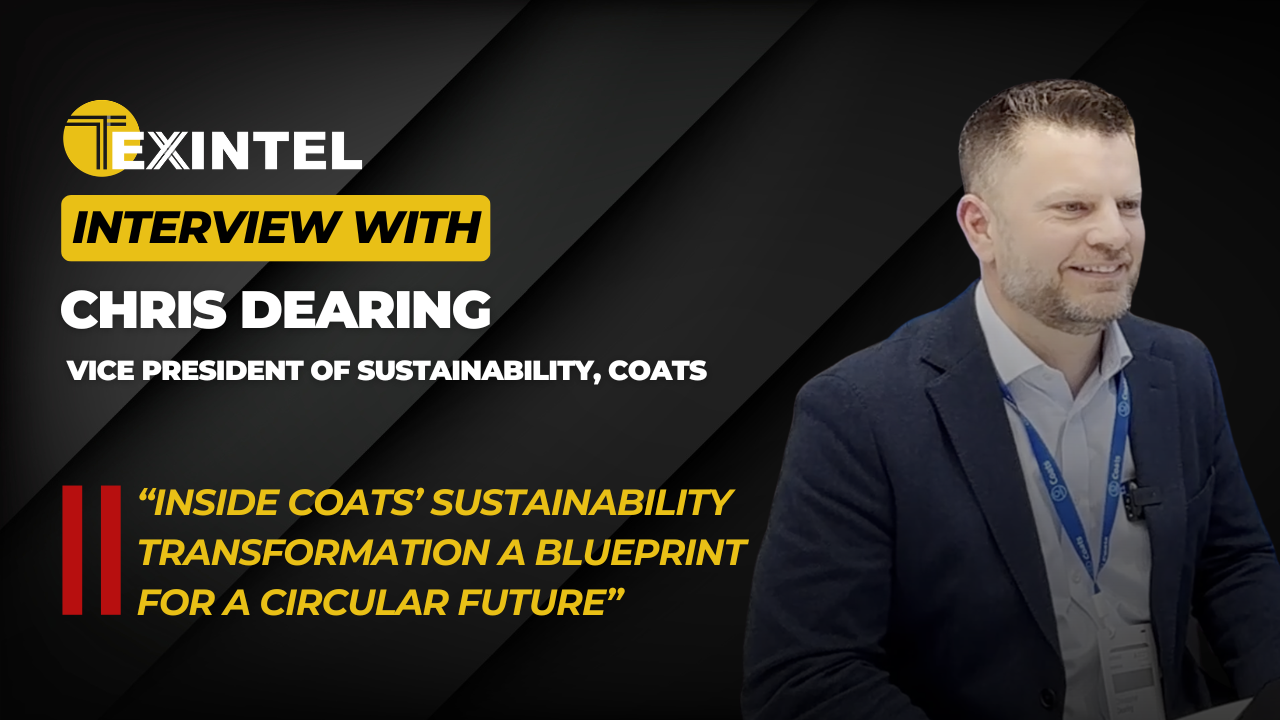
In a recent interview Chris Dearing, Vice President of Sustainability at Coats, outlined how the business is rewriting the rule book on resource management.
WATCH NOW »
Key Strategic Pillars:
The conversation reveals a profound shift in mindset at Coats, anchored by a five-pillar sustainability strategy (energy, materials, water, waste, and people) established in 2019. Here are the core strategic takeaways from their discussion:
Decarbonising Energy Intensive Processes
Thread manufacturing - specifically spinning, twisting, and dyeing - is highly energy-intensive. Instead of relying on offsets, Coats is actively transitioning its operations to renewable energy. Currently, 62% of their electricity comes from green-certified sources, with a resolute commitment to reach 100% by 2030. By setting science-based targets (SBTi) to reduce Scope 1, 2, by 46% by 2030, scope 3 emissions 33% by 2030, and targeting net-zero by 2050, Coats is providing the robust infrastructure their brand partners require to meet their own climate goals.
Reimagining Waste as a Raw Material
Perhaps the most significant revelation from the interview is Coats' approach to waste. The business has fundamentally shifted its perspective, treating waste not as an end-of-life problem, but as a primary resource for new product innovation. This cultural pivot enabled Coats to achieve zero waste to landfill across all global operations a full year ahead of their 2026 target.
Scaling Circular Material Innovations
Coats is aggressively transitioning away from virgin oil-based materials. While they initially relied on cross-industry recycled materials (like PET bottles), they are now pioneering textile-to-textile recycling. This includes developing high-tenacity sewing threads - T2T Epic/Gramax: from recycled textiles that match the intrinsic viscosity, colour fastness, and technical performance of virgin materials. Additionally, and for the Apparel division, Coats has launched 'EcoCycle' a water-dissolvable thread that enables cost-effective disassembling of garments for recycling. And EcoRegen: A 100% lyocell, biodegradable, and compostable thread made from wood pulp.
A Blueprint for the Textile Industry
The transformation at Coats provides a vital blueprint for the wider textile and apparel sector. True sustainability cannot be achieved in silos. As Dearing emphasised:
“Cross-industry collaboration is the engine of meaningful change. Brands, machinery suppliers, chemical providers, and fibre producers must act as an interconnected ecosystem”.
When a business of Coats' magnitude signals that 95% of its brand customers have science-based targets, it becomes clear that sustainable innovation is no longer a niche market advantage; it is the fundamental baseline for the future.
Action Points for the Global Supply Chain
To catalyse this shift across the industry, textile supply chain leaders must adopt the following actionable steps:
Audit and Transition Energy Sources: Commit to aggressive, SBTi-aligned emissions reductions. Evaluate and pilot the electrification of fossil-fuel resources and push to transition your operations to 100% green-certified renewable electricity.
Embrace Textile-to-Textile Circularity: Move beyond simply using recycled plastics from other industries. Work with innovation partners to develop and scale textile-to-textile recycled products that meet high-tenacity technical requirements without compromising quality.
Eradicate Landfill Waste: Foster a strong, internal delivery culture that views all industrial waste as a potential raw material. Set strict deadlines to achieve zero waste to landfill across all operations.
Invest in Biodegradable and Bio-based Alternatives: Allocate R&D resources towards scaling biodegradable components to address the end-of-life challenges of complex consumer goods.
Form Strategic Ecosystem Partnerships: Collaborate deeply with machinery, dye, and chemical suppliers.